| |
 |
 |
| |
High
Level Walking |
 |
 |
| |
|
| |
|
|
| On
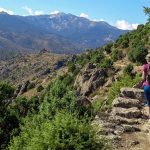
the Sella Summit plateau looking down the Val Lasties. |
Having
a break descending the 'Hidden Valley' with Conturines
behind. |
 |
| organised
high level walking
|
| In
each village, Collett's organises five high level walks
a week, which anyone is welcome to join at no extra
cost. These spectacular walks allow us to show you some
of the most awe-inspiring routes in the Dolomite range.
|
| |
| On
the Fanes above Pedraces with Corvara and Arabba in
the distance. |
 |
| being
independent |
|
| |
| Ideas
& Information Files & Route Laminates* |
|
 |
| If
you would prefer to walk independently, help
and advice is always at hand. Either come to
our small resort offices in Arabba, Corvara
and Pedraces, or drop into 'Office Hour', where
you can chat to (and look over a map with) someone
who knows the walks. Alternatively, our 'Ideas
& Information Files' outline over 30 outstanding
low, medium and high level walks with details,
duration and degree of difficulty with the relevant
map section included and the opportunity to
borrow the corresponding 'Route Laminate', as
described here.
|
 |
Please see our General Information for important notes
entitled ‘Walks
& Via Ferratas’, which apply to all
walks and are at your own risk (Organised or
Independent). |
| |
|
| |
| |
Rifugio Pisciadu (2585m). |
Rifugio
Lagazuoi (2752m). |
|
|
|
Rifugio
Vallon (2,500m). |
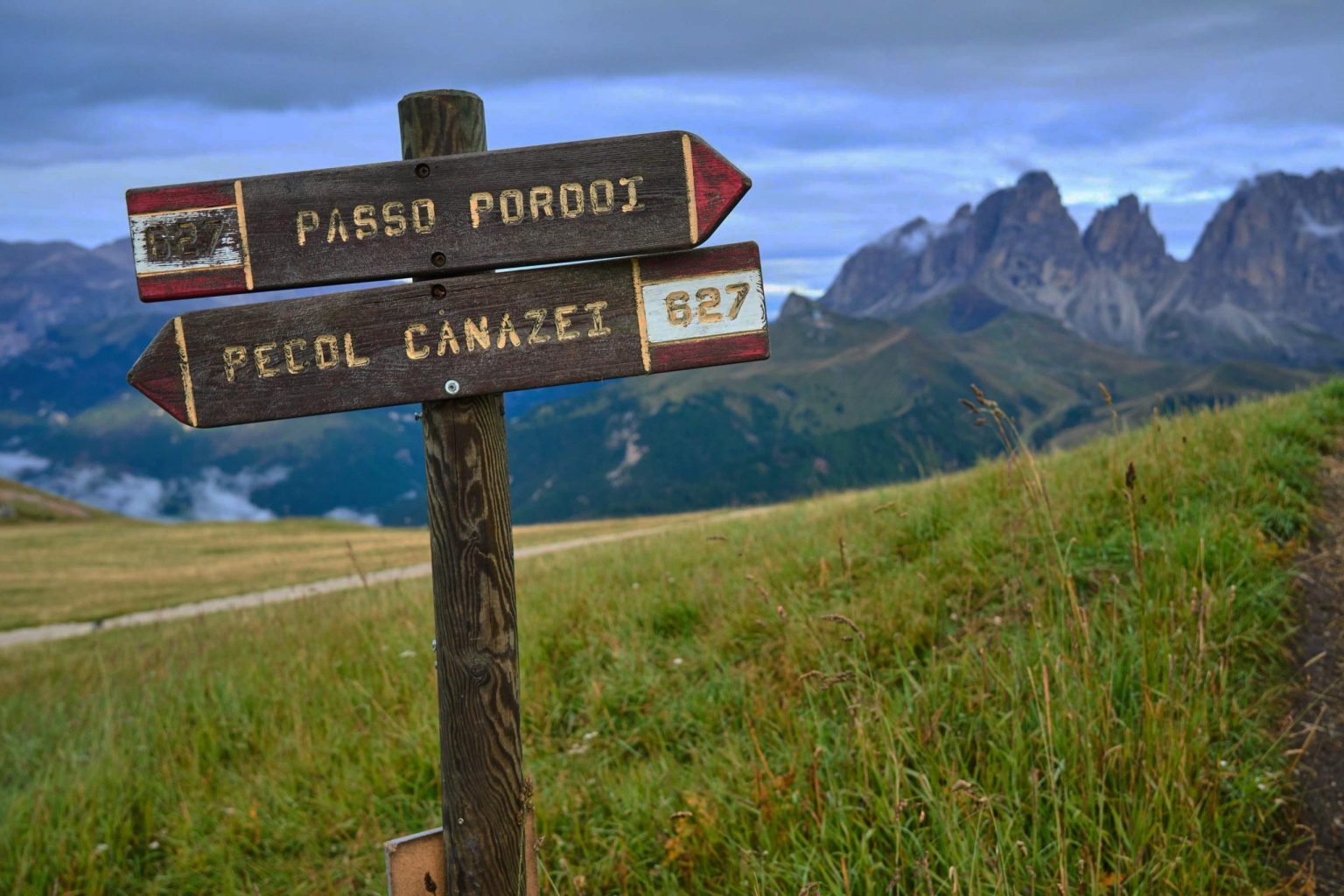
Signs
to Rifugio Pisciadu. |
|
 |
| Rifugio
Pisciadu(2585m), High on the Sella Massif above the Val Badia,
Pedraces & Corvara. |
| high
level protected paths |
Protected
paths will bring even more adventure and exhilaration to the
high level walker.They are, in fact, the very simplest form
of the Via Ferrata (Grade 1a) and they exist because of the
exceptional physical nature of the high Dolomitic terrain,
so a head for heights and surefootedness are essential. |
 |
| Fixed
cables assist walkers on ledges, while bridges precariously
span spectacular gorges to keep you on the move.These routes
are breathtaking and on them you will access places and panoramas
that will stay with you forever. Like the Via Ferratas, some
protected paths are old troop paths from the First World War.The
principal areas of interest are Lagazuoi and Cinque Torre,
both major theatres of war and both located near the Falzarego
Pass, which is easily accessed and equi-distant to Arabba,
Corvara and Pedraces. |
 |
|
|
| Protected
path above Pedraces. |
Protected
WWI path, on Monte Piana. |
|
 |
| the
great war |
| Some high
level areas will fascinate those interested in World War I.When
Italy declared war on Austria in 1915, fighting broke out
in the Dolomites because the border ran through the mountains.
Committed to the Russian front, Austria abandoned political
boundaries and retreated to defendable mountain tops and passes.
A tragic and inconclusive conflict ensued, as both sides pushed
for high positions in the massifs. They ingeniously built
fortifications, trenches, look-out posts and miles of tunnels.
Freezing temperatures and snow exacerbated the situation. |
 |
     |
| Protected
Austrian troop path. |
Descending
from Monte Lagazuoi, before the troop path. |
Approaching
the Sella Summit.. |
|
|
The
winter of 1916 was bitter and with 10 metres of snow,
10,000 men died as a result of avalanches. On the Marmolada,
4000 soldiers died in one single avalanche. Neither
side won and with little recognition of the actual events,
the region's destiny was determined far from the battle
zone in Paris in 1919. |
 |
|
| 1916. |
2006. |
|
|
Descending
the Austrian Troop Path, part of the open air
museum |
|
 |
| Near Arabba and
Pedraces at the Falzarego Pass is Monte Lagazuoi, an
area of great strategic importance during the conflict.
Here, a remarkable amount of tunnelling took place,
as both sides sought to break through enemy lines. Such
was the proximity of the two sides, hand-to-hand combat
was common and troops slept within earshot of the enemy.
On one occasion the Italians constructed some 1,100
metres of tunnels to explode a mine beneath Austrian
positions. The Austrians heard them and retreated in
time. |
 |
| open
air first world war museum |
 |
| Today, along
with Cinque Torre, just along the road, Monte Lagazuoi
is an open-air WWI museum and a popular location for
walkers. Several high level routes converge on the area.
For non-walkers, a cable car rises from the pass to
a spectacular 360° panorama.You can enjoy this from
the sun terrace of the Rifugio Lagazuoi, perched above
the cable car station. From the cable car, you will
see Lagazuoi's face with its ledges and 1916 2003 The
trenches of the open-air WWI Museum at Cinque Torre.
observation posts, each one an off-shoot from the labyrinth
of tunnels that exist in the mountain.These tunnels
recently underwent maintenance and are now open for
you to explore. One positive remnant of the fighting
in the Dolomites are the Via Ferratas… |
  |
You can buy
a pass which will give you access to the cable car ascent
to Lagazuoi, the chairlift ascent to Cinque Torre and
the indoor Museum at the nearby Tre Sassi Fort. |
|
|
 |
|
 |
|
|