| |
 |
 |
| Alpine
Flower Walks |
 |
|
 |
| wildflower
strewn meadows |
|
|
| |
Wildflower
Walks |
in
a nutshell |
|
|
 |
Organised
Flower Walks |
| |
Five days a week (not Wednesday or Saturday) during
June and July only, we offer a flower walk in each
of our resorts. |
|
| Most
walks could be categorised as 'easy' or 'intermediate'.
Occasionally, the walks are 'static', whereby we
go to a specific area of interest and potter generally
amongst the various species. |
|
These
walks are free of charge and completely optional.
If they interest you, simply drop into |
Office
Hour to sign up for the next day's itinerary.
Walks set off after breakfast at about 9 - 9.30am.
We usually take a packed lunch and return to the
village mid afternoon, depending on the length and
location of the walk. |
 |
Spectacular
Scenery |
|
| |
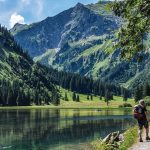
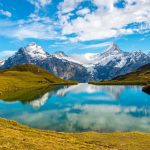
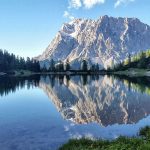
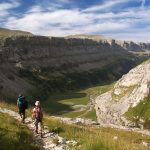
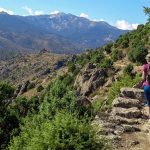
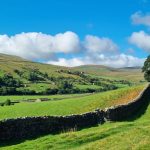
Expect
lowland and upland meadows, woodland trails, riverside
tracks and sleepy hamlets, all with the spectacular
massifs towering high above. |
|
 |
Be
Independent |
| |
The
advice and guidance of our Wildflower Enthausiasts
is available each evening at Office
Hour. For anyone with an interest in flowers
who would prefer to go out independently. |
 |
Presentation |
| |
Once
a week in each of our three resorts our Wildflower
Enthausiasts give a presentation and a talk, which
will entertain anyone with an interest in alpine
flora. |
|
 |
|
|
|
| hundreds
of different species |
 |
| This
is an outstanding area for wildflowers and it is one
of life's great pleasures to walk among them. The Dolomites
present a slightly different geology from the main alpine
chain and many rare species are at their best here,
notably Campanula morettiana, Eritrichium nanum, Paederota
bonarota, Papaver rhaeticum, Potentilla nitida, Ranunculus
seguieri and the very beautiful Physoplexis comosa.
The villages of Arabba, Corvara and Pedraces are on
the doorstep of some of the most renowned floral sites
in the Alps, such as the Bindelweg, the Belvedere, Pordoi,
the Sella, Selva and the Val Gardena. |
 |
|
|
| Stalking
Wildflowers with Cliff Booker in Meadows above Arabba. |
|
| |
     |
 |
Habitats
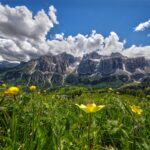
vary from vivid and profuse upland meadows teeming with orchids
and wildflowers to rocky outcrops where countless alpine gems
thrive in the most perfect of settings. In spring, as the
snow retreats to the highest peaks, crocuses and hepaticas
appear and the flower season begins. By mid/late June, the
alpine pastures are smothered in startling colour - the yellows
of the arnicas, geums and poppies - the pinks, mauves and
reds of the soldanellas, daphne, primulas and rhododendrons
- the stunning blues of the campanulas and gentians and, in
its high mountain home, the 'King of the Alps', Eritrichium
nanum. July enhances this botanical array with edelweiss,
lilies, potentillas and orchids, creating a truly floral paradise
under a high summer sun. |
 |
| organised
flower walks |
|
|
 |
| Throughout
June and July when the flora is at its best, we organise
five flower walks a week with a dedicated enthusiast
who has an intimate knowledge of the flora and who will
help you find the profuse, the spectacular and the rare.
On a few occasions, these walks will be 'static'; in
other words, instead of walking a prescribed route,
the day is spent in one location of specific excellence.
Our wildflower enthusiasts are often accomplished floral
photographers and will be pleased to help you capture
these exquisite subjects. In the evening, they offer
|
| the occasional talk or slide
show, where, |
|
Photographing
the ‘Devil’s Claw’ (Physoplexus comosum). |
| as with the
walks, the person with a layman's interest will be as
much at home as the passionate enthusiast. |
 |
| If
you would like to know more about the flora, we can
send you, by kind permission of the Alpine Garden Society,
an extract from 'Mountain Flower Holidays in Europe'
by Lionel Bacon. It will convince you this is an exceptional
area for flowers.We can also send you a list of all
the species spotted in June and July 2006 by Ruth Croome,
our wildflower expert in the Val Badia in Summer 2006.
Ruth, who is back with us in Summer 2007, is currently
working on her Dolomites Flower Book, a user-friendly
guide for the layman - please contact us if you would
like a copy hot off the press. |
 |
|
flowers
in summer 2006 |
| A
splendid array of alpine plants characterised
our walks in 2006 and from the onset of a quite
early spring we were rewarded with a diversity
and richness of flora that lasted well into
the cooler days of autumn. Photogenic patches
of snow lingered on the screes and high ridges
even into late June, but choice spring flowers
flourished in the woods, meadows and valleys
from mid-May onwards. The upland pastures around
Arabba and Pedraces were awash with sheets of
colour for much of the year. At higher altitudes
well-marked paths afforded access to vast sun-baked
screes dotted with iridescent alpine gems, while
the loftier but still accessible ridges cradled
rare and enchanting species. |
| |
|
|
Crocus
albiflorus (1) |
Trollius
europaeus (2) |
Pulsatilla
vernalis (3) |
|
| As
always, dainty purple and white Crocus
albiflorus (1) were one of the first
species to bloom, bedecking the lush green meadows
with their varied hues.These fragile bulbous
gems were stunningly augmented by the golden-yellows
of the globeflowers (Trollius europaeus)
(2), massed in floral profusion on
the upper flanks of the now quite verdant valleys,
both were then shortly joined by the unrivalled
beauty of the pasque flowers, illustrated here
by the sublimely hairy Pulsatilla vernalis
(3). |
| |
|
|
Gentiana
acaulis (4) |
Geum
reptans (5) |
Lilium
martagon (6) |
|
| Every
colour of the rainbow seemed to be represented
during the warm midsummer months when the dramatic
blues of the gentians vied for attention with
the yellows of the geums, the whites of the
mountain avens and the lustrous pinks of the
primulas, rhododendrons and potentillas. The
adjective gentian evokes the deepest of blues
and the trumpet gentians; (Gentiana
acaulis) (4) did not disappoint with
their clusters of royal blue open-mouthed goblets
soaking up the radiant warmth of a hot summer
sun. Butter yellow geums; (Geum reptans)
(5) and the stately martagon lilies
with their pendulous purple-pink flower heads
(Lilium martagon) (6) flourished
in the sun drenched rocky outcrops, while deep
magenta flushes of Potentilla nitida
rubra (7) and Silene acaulis spread
gracefully from the abundant crevices of the
cliffs and boulders. |
| |
|
|
Potentilla
nitida rubra (7) |
Arnica
montana (8) |
Dianthus
superbus (9) |
|
| The
surrounding meadow turf teemed all summer long
with beautiful orchids,burnt-yellow arnicas
(Arnica Montana) (8); the pastel
pinks of primulas and the filigreed flowers
of the exquisite Dianthus superbus (9).
These often wet grassy slopes also supported
vast colonies of the delightful spring gentian
(Gentiana verna) (10), it's
tiny upward-facing flowers reflecting the often
azure blue of a clear dolomitic sky…much
smaller in all it's parts than it's trumpeted
relative (Gentiana acaulis) this beautiful harbinger
of spring covered wide expanses of hillside
on the Pordoi and Sella passes in particular. |
| Meanwhile,
at lower altitudes, damp shaded glades in wooded
areas were enriched by the majesty of the ladies-slipper
orchids; Cypripedium calceolus (11),
a plant now virtually and sadly lost to our
woodlands here in Britain. Here, however, in
this limestone haven, these glorious orchids
really flourished in the summer of 2005, much
to our complete pleasure. |
| |
|
|
Gentiana
verna (10) |
Cypripedium
calceolus (11) |
Paederota
bonarota (12) |
|
| A
vast array of species carpeted the route of
practically every walk, whilst those with a
head for heights could discover a rare endemic
such as Paederota bonarota (12) in
one of the barren limestone outcrops or the
gorgeous honey-scented Thlaspi rotundifolium
(13) on an exposed scree and, if particularly
fortunate, one may have been personally greeted
by the 'untameable' 'King of the Alps'; Eritrichium
nanum (14). This sky-blue, yellow-centred
gem forms tight, hairy cushions on boulders
at the highest of altitudes and flowered profusely
during much of June and July 2005. |
|
|
 |
| |
|
Thlaspi
rotundifolium (13) |
Eritrichium
nanum (14) |
The
seasons may change (whether early or late) and those
fragile limestone pinnacles may occasionally crumble
but time does not erode the beauty of these majestic
mountains and their spectacular Dolomitic flora. In
2005, Arabba, Corvara and Pedraces were only one small
step away from these magnificent plants.
Text & photography:
Cliff Booker
To see two further reports
by Cliff Booker about the Dolomites on the Scottish
Rock Garden Website click the following links; www.srgc.org.uk/part
one & www.srgc.org.uk/part
two.
|
|
|
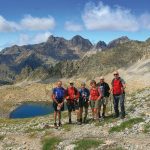
Stalking
wildflowers with Ruth Croome. |
|
|
|
|
|